


You have a sharp idea. You know your industry. You can see the problem in plain sight.
Now you’re wondering if AI can turn that idea into a product customers will pay for. You also might be thinking, “I’m not a machine learning engineer, so where do I even start?”
This guide is for non-technical founders who are considering AI software development. We’ll cover when you truly need AI, what the build process looks like, who you need on the team, and how to budget without guessing.
If you want a real example of what “AI MVP” can look like, see our AI MVP case study, which shows how an idea became a working product through focused scoping and execution.
What AI Software Development Means for a Founder
Think of AI as a tool, not the product.
The job is not to “add AI.” The job is to solve a specific customer problem in a way that’s fast, reliable, and worth paying for.
That starts with business questions:
- Who has this problem and how often?
- What does a good outcome look like?
- What would someone pay to get that outcome?
- Is AI the simplest way to deliver it?
The biggest risk is not the model failing. It’s building something nobody wants, or nobody will pay for.
That is why strategy has to come first. It keeps you from spending months building the wrong thing.
When You Actually Need AI (and When You Don’t)
Most founders don’t need AI for version one. Many problems are better solved with standard software, especially early on.
Here’s the clean way to think about it:
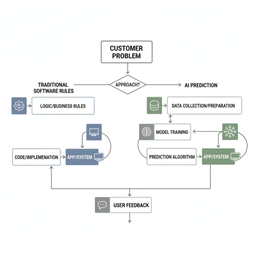
- Traditional software follows rules you write. If X happens, do Y.
- AI systems learn patterns from data and make predictions. They are not perfect, they are “usually right.”
Good signs you need AI
AI tends to be the right fit when rules are hard to write down or too complex to maintain.
- You’re working with messy inputs. Text, audio, images, and long documents are hard for rule-based systems.
- The output needs personalization. Recommendations and ranked results are classic AI use cases.
- The “right answer” depends on lots of signals. Churn prediction, fraud detection, and lead scoring often fall here.
Good signs you should start with traditional software
- You can write clear rules. If you can list the decision steps on a whiteboard, start there.
- You don’t have reliable data yet. You may need to build the workflow first to create the data.
- You need speed to market. A simple MVP often proves demand faster than a complex AI build.
The goal is not to build with AI. The goal is to choose the simplest tool that solves the user’s problem.
AI vs traditional software: quick comparison
| Business Problem | Traditional Software (Good For…) | AI (Needed For…) |
|---|---|---|
| Managing Customers | Storing contacts, stages, and tasks in a CRM. | Predicting churn or next-best-action from behavior patterns. |
| Content Management | Manual publishing, editing, and tagging. | Summaries, auto-tagging, or topic classification at scale. |
| E-commerce | Fixed categories and “related items” rules. | Personalized recommendations based on sessions and purchase history. |
| Customer Support | FAQ + ticket form + routing rules. | Natural language help, intent detection, and automated responses with handoff. |
The Real Process of Building an AI Product
AI product work is not magic. It’s a sequence of steps that reduce uncertainty as you go.
Most projects follow this order: strategy, data, model, application, launch, iteration.
1) Strategy: de-risk the idea before building
This phase turns an idea into a plan your team can build.
You define:
- The target user and the job they need done
- The smallest “version one” that creates value
- What the AI needs to do and what it does not need to do
- How you will measure success after launch
A simple way to keep this clean is to write a spec the team can align on. This is where a strong product requirements document helps, because it forces clarity on scope, inputs, outputs, and edge cases.
2) Data: get the right inputs, not “all the data”
AI quality is limited by the quality of your inputs.
This stage answers:
- What data already exists in your business?
- What data is missing?
- Who owns it, and can you legally use it?
- How will data be collected going forward?
In many early products, the best move is to start with a narrow dataset and expand later. That keeps the first release focused and easier to debug.
3) Model: choose build vs buy
Most founders do not need to train a model from scratch.
A common approach is to start with a pre-trained model via API, then adjust based on what real users do.
- Using an API model: Faster to ship, lower up-front cost, great for MVPs.
- Fine-tuning: Useful when you need brand voice, consistent formatting, or domain-specific behavior.
- Custom model training: Best when you have unique data, strict performance needs, or you need full control.
A model by itself is not a product. The product is the workflow around it.
If your product needs up-to-date context from internal docs, tickets, or databases, you may also hear the term “RAG.” This is a practical pattern used in many apps, and this guide on real-time RAG pipelines is a helpful overview.
4) App development: turn the model into something people can use
This is the part many founders underestimate. The AI feature has to live inside a real product.
That means:
- UI screens, flows, and error states
- User accounts, roles, and permissions
- Billing, audit logs, and admin tools (for many SaaS apps)
- Monitoring and analytics so you can see what’s working
This is where strong execution in website development services matters, because the product still needs solid engineering foundations, even if the “AI brain” comes from an API.
5) Launch and iteration: AI products improve after release
Launch is not the finish line.
After release, you’ll want to track:
- Accuracy and failure cases
- User retention and repeat usage
- Time saved or revenue created
- Support load and risk issues
Many teams also invest in website optimization services once the MVP is live, so performance, conversion, and measurement improve with each release.
Building Your Team and Tech Stack
You don’t need a huge team. You need the right mix of roles.
The right setup keeps the project focused on user value, not research projects.
The core roles for an AI product
- Product strategist: Defines the problem, success metrics, and MVP scope. Keeps everyone aligned.
- UI/UX designer: Turns the capability into a simple flow. Sets the right expectations for users.
- Data scientist or ML engineer: Handles data, evaluation, and model behavior.
- Full-stack developer: Builds the app, integrations, and infrastructure around the AI feature.
If you’re hiring these roles yourself, you’ll want a plan for screening and onboarding. This guide on hiring developers breaks it down in founder-friendly terms.
A practical modern AI stack
The goal is to pick tools that ship quickly and are easy to maintain.
- Python for data work and model orchestration
- React/Next.js for fast web apps and dashboards
- AWS (or similar) for hosting, security, and scaling
- OpenAI or Anthropic for strong general-purpose models
Team workflows are changing fast too. Deloitte’s software industry outlook is a useful read if you want context on how AI is shaping product teams and expectations.
Good design still matters just as much as engineering. If you need help translating AI capabilities into something users trust, strong UI/UX design services can make the difference between a demo and a product.
Budgeting for AI: What This Actually Costs
AI costs vary because the work varies.
A simple AI feature inside a small app can be tens of thousands. A larger system with custom data pipelines, privacy controls, and model work can move into six figures.
The three biggest cost drivers
- Data complexity: Clean tables cost less than scattered PDFs, images, and notes.
- Model approach: API-based builds are often cheaper than custom training.
- App scope: A single workflow costs less than a full SaaS product with roles, billing, and analytics.
How to keep the budget under control
The most reliable way to manage cost is to work in phases.
Start by defining a tight MVP, then build, then measure, then expand. That keeps you from paying for features before you know users want them.
Timelines also tie directly to cost. If you want a clearer way to plan, this guide on estimating software development time helps founders set realistic expectations.
Hiring and team costs
If you’re comparing “hire vs partner,” you’ll want real salary and contractor ranges.
This breakdown of how much it costs to hire an AI developer is a helpful reference point for early budgeting.
Where to Go From Here
If you’re a non-technical founder, your advantage is not writing model code. Your advantage is knowing the customer, the workflow, and the business case.
Your next step is to get clear on three things:
- What problem you’re solving first
- Whether AI is required or optional
- What the smallest paid version looks like
If you want help scoping the MVP and pressure-testing the plan, book an intro call. We’ll talk through your idea in plain language and map a practical path to a real product.
Common Founder Questions About AI Development
How much data do I really need?
It depends on the approach.
If you are using a strong pre-trained model from OpenAI or Anthropic, you may need only a few hundred examples to guide prompts, set formats, and test quality.
If you need a system that learns a niche domain or unique patterns, you may need thousands, or more, of high-quality examples. The key is not volume alone, it’s whether the data matches the job your model needs to do.
A data audit early on can save months of work later.
What’s the single biggest risk?
The biggest risk is a business risk.
You can build a technically impressive AI feature that nobody uses. Or users try it once and never come back. That usually means the workflow did not solve a painful problem, or it did not fit into how people already work.
Technical issues can often be fixed. A weak problem choice is harder to recover from.
How long does it take to build an AI MVP?
Most MVP timelines fall into two buckets:
- API-driven MVP (3–6 months): You’re integrating an existing model into a user-facing app with clear use cases.
- Custom model MVP (6–12+ months): You need data collection, labeling, training, and extra testing before the app is ready.
The fastest path is usually to ship a focused workflow with an API model, learn from users, then invest more where it pays off.
If you’re ready to turn your idea into a plan you can build, schedule a conversation with Refact. We help founders scope, design, and build products that ship.


